
Contract Respiratory Therapist Staffing for Acute Care ICUs and LTACH Facilities
Acuity Clinical Group provides elite veteran Respiratory Therapists for Acute Care ICUs and Long‑Term Acute Care Hospitals (LTACHs) in Southeast Michigan. We deliver clinical excellence, rapid deployment, and reliable contract staffing.
-
Acuity Clinical Group is built on decades of advanced respiratory practice within acute environments. Our clinicians bring deep competency in ventilator management, weaning protocols, secretion management, and the complex needs of medically fragile, patients. Every RRT we place reflects the seasoned judgment, clinical precision, and high-standard of care required to support safe, stable patient management.
-
High-acuity hospitals and LTAC operations depend on consistency — and that’s exactly what we deliver. Our respiratory clinicians integrate seamlessly into existing workflows, maintain dependable shift coverage, and uphold the standards expected in high‑acuity settings. We prioritize stability, professionalism, and readiness, ensuring your teams can rely on experienced clinicians who require minimal retraining, no hand‑holding, and no operational disruption.
-
Acuity Clinical Group was founded on a simple premise: High‑acuity environments deserve respiratory clinicians with proven mastery, not generalists. Our leadership brings decades of frontline experience, shaping a company built around clinical excellence and operational discipline. We exist to provide a level of respiratory expertise that strengthens patient care and supports the teams who deliver it.
Who We Are
Meet Our Founders

Mary brings nearly 30 years of high‑acuity respiratory care experience to Acuity Clinical Group. As a seasoned Registered Respiratory Therapist (RRT), she has deep expertise in respiratory disease management, including complex pulmonary rehabilitation and critical‑care patient stabilization — setting the clinical standard that defines Acuity’s reputation.
Mary earned her AASc in Respiratory Therapy from Delta College and a BS in Applied Science from the University of Michigan–Flint, giving her a strong foundation in respiratory pathophysiology, ventilator management, and long‑term acute care complexity.
Across three decades, she has become known for her ability to step into the most demanding environments and deliver immediate, reliable, expert‑level support. Her calm judgment and mastery of advanced respiratory interventions make her the clinician hospitals and LTACs can rely on to stabilize their most fragile patients.
Clinical Philosophy:
Hospitals and LTACs deserve clinicians who function at a high skill level with care and compassion — and patients deserve nothing less.
Mary B. MacLean, RRT | Co‑Founder & Lead Clinical Therapist
Michael leads the strategic and operational solutions of Acuity Clinical Group. His career blends rigorous academic training with hands‑on leadership, giving him a uniquely qualified approach to solving financial and operational challenges.
He earned his Doctorate in Strategy at the University of Michigan–Flint, an MBA in Global Leadership at Kettering University, an MS in Accounting at the University of Michigan–Flint, and an MA‑Law in Wealth Management at Regent University School of Law. This multidisciplinary education shapes his approach to strategic planning, clinical economics, and organizational performance.
Michael is also the Principal & Lead Strategic Equities Analyst with APEX Intrinsic Research, where he audits the SEC filings and footnotes of small-cap biotech firms. Prior to this, Michael held positions as a Financial Planner with MACLEAN & Co. Financial Planning, Financial Advisor with Edward Jones, and Equities Trader (Nasdaq) with Olde Discount Stockbrokers.
Leadership Philosophy:
Pay clinicians what they’re worth, deliver uncompromising reliability, and elevate the entire ecosystem.
Michael H. MacLean, DBAc | Co‑Founder & Managing Director
Clinical Capabilities

We bring immediate stability to high‑acuity respiratory environments.
Acuity Clinical Group provides experienced RTs who specialize in ventilator management, weaning oversight, and rapid intervention for deteriorating patients. Our teams integrate directly into your clinical workflow, ensuring consistent coverage, predictable performance, and safe progression of complex respiratory cases.
Stabilized patients protect census, throughput, and revenue.
By preventing avoidable transfers, reducing complications, and maintaining continuity of care, we help high-acuity hospitals and LTACs preserve vent DRG capture, avoid LOS penalties, and maintain the clinical stability required for financial performance.

We eliminate the operational volatility that disrupts patient care.
Acuity Clinical Group provides dependable, high‑acuity RT coverage that integrates seamlessly into your existing staffing model. Our teams are scheduled, managed, and deployed to ensure uninterrupted clinical operations — even during census swings, call‑offs, or high‑acuity surges.
Predictable coverage protects clinical quality and hospital workflow.
By maintaining consistent staffing, we reduce delays in care, prevent gaps in respiratory oversight, and support smoother throughput across the facility. The result is a stable clinical environment where patients progress safely and your internal teams can operate without disruption.

Stable respiratory care protects the financial engine of hospitals and LTACs.
Acuity Clinical Group helps hospitals preserve vent DRG capture, avoid LOS penalties, and prevent denials tied to respiratory instability. By maintaining consistent oversight of high‑acuity patients, we reduce avoidable transfers, prevent clinical setbacks, and support safe, timely progression of care.
When patients stay stable, revenue stays intact.
Our teams ensure the respiratory continuity required for compliant documentation, predictable throughput, and strong reimbursement performance. The result is a more reliable census, fewer financial disruptions, and a stronger bottom line.
Our Commitment to Our Partners
We operate as an extension of your hospital, not a staffing vendor. Acuity Clinical Group is built on the belief that hospitals and LTACs deserve partners who understand the clinical, operational, and financial pressures of high‑acuity respiratory care. Our teams integrate seamlessly with your staff, uphold your standards, and support the stability your patients and leadership depend on.
We prioritize safety, continuity, and predictable outcomes. Every clinician we deploy is selected for their experience, judgment, and ability to manage complex respiratory cases. We maintain consistent coverage, clear communication, and a disciplined approach to care — ensuring your hospital can rely on us every shift, every day.
Your goals become our goals. Whether it’s stabilizing high‑acuity patients, protecting revenue, or supporting throughput, we align our work with the outcomes that matter most to your hospital or LTAC. Our commitment is simple: deliver the clinical stability that strengthens your hospital’s performance.

How Respiratory Stability Protects Revenue
High-acuity respiratory care has a measurable impact on financial performance.
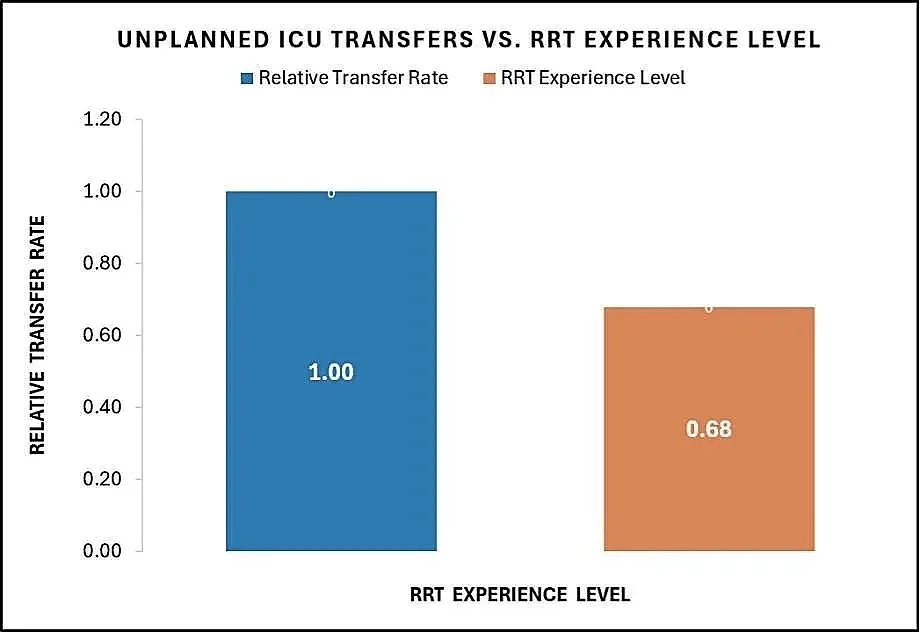
When ventilated patients remain clinically stable, hospitals avoid costly transfers, protect vent DRG capture, and maintain predictable reimbursement. The visualization below shows how increasing high‑acuity RRT coverage reduces respiratory‑related revenue loss and strengthens financial outcomes.
Standard‑Experienced RRTs are the baseline, at 1.00 (100% of the transfer rate).
High‑Acuity RRTs have a value of 0.68 (32% fewer unplanned ICU transfers).
More experienced, high‑acuity RRTs prevent more escalations, which keep patients stable and revenue in the building.
Source: Miles, A. H., Spaeder, M. C., & Stockwell, D. C. (2015). Unplanned ICU transfers from inpatient units: Examining the prevalence and preventability of adverse events associated with ICU transfer in pediatrics. Journal of Pediatric Intensive Care, 5(1), 21–27. https://doi.org/10.1055/s-0035-1568150
Revenue Retention Scales Rapidly Across an RRT’s Monthly and Annual Workload
High‑acuity RRTs materially change the financial trajectory of hospitals and LTACs by reducing the single most expensive clinical failure point: unplanned ICU transfers. The published literature shows a 32% reduction in these escalations when high-acuity RRTs manage the caseload. Because each unplanned ICU transfer represents roughly $15,000 in lost revenue, that reduction translates into approximately $4,800 in revenue retained per patient under the care of a high‑acuity RRT. When applied across a typical respiratory load of six patients per 12‑hour shift, the financial impact compounds quickly — yielding $28,800 in revenue retention per shift simply by preventing the setbacks that strip DRG value out of the building.
When scaled to an RRT’s real schedule, the numbers become even more compelling. At three 12‑hour shifts per week, a single high‑acuity RRT protects roughly $86,400 in revenue per week, or $345,600 per month, by stabilizing patients and preventing avoidable transfers. Over a full year, that same therapist safeguards an estimated $4.1 million in revenue, driven entirely by improved respiratory stability and fewer escalations. The takeaway is direct and defensible: high‑acuity RRTs don’t just improve care — they materially preserve the revenue that hospitals and LTACs are built on.